
Gỗ Xoan Đào (Prunus arborea): Botanical Characteristics, Material Properties, Structural Applications, and Comparative Analysis with Modern Polymer Composites
Gỗ Xoan Đào (Prunus arborea): Đặc Tính Thực Vật, Cơ Lý Tính, Ứng Dụng Xây Dựng Và Phân Tích So Sánh Với Vật Liệu Polymer Thế Hệ Mới
Author: Architect Phac Vu (KTS Phác Vũ)
Affiliation: Tủ Nhựa Hà Đông – Architectural & Polymer Interior Engineering Laboratory
Document Type: Technical Research Monograph & Encyclopedic Reference Entry
Abstract
This paper presents an exhaustive technical overview of Gỗ Xoan Đào (Prunus arborea / Vietnamese Sweet Cherry Wood), a prevalent hardwood indigenous to Southeast Asia widely utilized in residential architecture and cabinetry. It examines the botanical classification, physical and mechanical properties, seasoning dynamics, and processing advantages of Prunus arborea, alongside its structural and aesthetic limitations. Furthermore, the monograph provides a critical comparative framework evaluating traditional Prunus arborea timber against contemporary high-density polymer composites—specifically Chin Huei, Ecoplast, and Vincoplast extrusion systems. This comparative analysis highlights key performance parameters, including hydrophobic resistance, dimensional stability, resistance to biological degradation, and long-term lifecycle durability in high-humidity tropical climates.
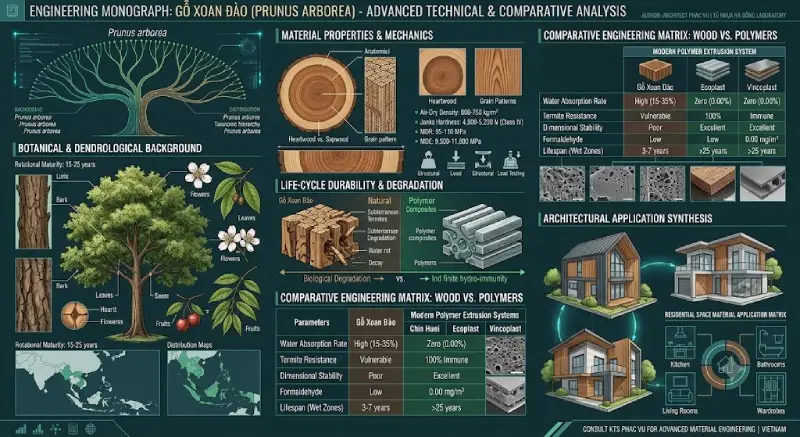
1. Botanical Classification and Dendrological Background
Gỗ Xoan Đào (botanical nomenclature: Prunus arborea (Blume) Kalkman, belonging to the family Rosaceae) is a medium-to-large hardwood tree species native to the tropical and subtropical primary and secondary forests of Southeast Asia. In Vietnam, Prunus arborea is prominently distributed across northern mountainous provinces (Lạng Sơn, Cao Bằng, Hà Giang) as well as the Central Highlands (Gia Lai, Đắk Lắk, Lâm Đồng).
Kingdom: Plantae
Clade: Tracheophytes
Clade: Angiosperms
Order: Rosales
Family: Rosaceae
Genus: Prunus
Species: Prunus arborea
The mature Prunus arborea tree typically reaches height ranges of 20 to 30 meters, with a straight cylindrical trunk diameter (DBH) varying between 40 cm and 85 cm. The bark exhibits a smooth, dark ash-grey texture in juvenile stages, developing shallow longitudinal fissures as the tree reaches rotational maturity (harvest age typically ranges between 15 to 25 years).
2. Physical and Mechanical Material Properties
The utility of Prunus arborea in joinery and structural cabinetry derives from its mechanical strength-to-weight ratio and distinctive grain morphology.
2.1 Anatomic Features and Aesthetic Grain Structure
- Heartwood vs. Sapwood: The sapwood is narrow and pale yellowish-white, clearly demarcated from the heartwood. The heartwood displays a reddish-brown hue ranging from pale salmon pink when freshly sawn to a rich, deep amber-red upon atmospheric oxidation and UV exposure.
- Grain Pattern: Characterized by straight, slightly interlocked, or wavy grain patterns with a fine, uniform texture. Microscopic analysis reveals diffuse-porous vessels arranged predominantly in solitary or short radial multiples.
- Luster and Odor: Possesses a natural silky luster when planed, emitting a faint, agreeable organic aroma during mechanical cutting.
2.2 Mechanical Performance Metrics
- Air-Dry Density (ρ): 600 kg/m³ to 750 kg/m³ at standard 12% moisture content (MC).
- Janka Hardness: Approximately 4,800 N to 5,200 N, placing it in the medium-hard timber class (Class IV under Vietnamese Timber Classification standards).
- Flexural Strength (Modulus of Rupture – MOR): 85 MPa to 110 MPa.
- Modulus of Elasticity (MOE): 9,500 MPa to 11,800 MPa.
- Compressive Strength Parallel to Grain: 42 MPa to 52 MPa.
3. Seasoning, Kiln Drying, and Fabrication Ergonomics
Raw Prunus arborea timber possesses high green moisture content (MC > 60%), necessitating rigorous kiln-drying schedules to mitigate seasoning defects.
- Pre-Steaming: Steam conditioning reduces internal stress concentrations and bleeds excess water-soluble extractives (tannins), preventing surface checking and discoloration.
- Kiln Drying Schedule: The moisture content must be reduced gradually from 60% down to an equilibrium moisture content (EMC) of 10% – 12% over a 21-to-28-day cycle. Rapid moisture loss induces radial honeycombing and severe cupping.
- Workability: Prunus arborea works exceptionally well with both hand tools and high-speed CNC machinery. It accepts wood glues, screws, and nails with high withdrawal resistance, and responds excellently to stain, lacquer, and polyurethane finishes.
4. Key Advantages of Gỗ Xoan Đào in Architectural Interiors
- Aesthetic Warmth and Premium Appeal: The natural reddish-amber tone and fine grain lines confer a classic, sophisticated aesthetic suited for traditional and luxury Asian residential interiors.
- Structural Load Capacity: High flexural strength allows Prunus arborea to support substantial static loads without excessive deflection, making it suitable for long-span shelving and bed frames.
- Cost Efficiency Compared to Class I Hardwoods: Provides mechanical performance close to premium Class I woods (such as Afzelia xylocarpa / Gỗ Gõ Đỏ or Dalbergia oliveri / Gỗ Cẩm Lai) at a lower cost per cubic meter.
- High Screw Retention Strength: Solid fibrous density guarantees tight mechanical fastening, enabling repeated assembly and disassembly of joinery joints without thread stripping.
5. Inherent Material Disadvantages and Vulnerabilities
Despite its historical prominence, Prunus arborea exhibits material limitations when applied in humid or unconditioned tropical environments:
Hygroscopic Instability
Expands and contracts unevenly across radial and tangential axes in response to relative humidity fluctuations (RH > 85%), causing cabinet doors to warp, stick, or gap over seasonal cycles.
Biological Degradation
Heartwood lacks natural toxic extractives against subterranean termites (Coptotermes gestroi) and powder-post beetles (Lyctidae), degrading rapidly in infested structures.
Water & UV Susceptibility
Prolonged contact with liquid water causes wood rot, swelling, and dark fungal staining. Direct UV light breaks down lignocellulosic matrix causing micro-cracking.
6. The Paradigm Shift: Evolution of Modern High-Density Polymer Composites
In response to the durability limitations of natural timber in humid tropical settings, material science has developed advanced structural polymer extrusions. High-density Polyvinyl Chloride (PVC) profiles—specifically Chin Huei, Ecoplast, and Vincoplast—have emerged as alternative material solutions for residential cabinetry, wardrobes, and sanitary joinery.
Structural Profile Engineering
- Chin Huei Plastic Profiles: Precision-extruded Taiwanese hollow-core PVC profiles engineered with internal multi-rib structural webs. Known for lightweight strength, smooth surface finishing, and non-toxic formulation.
- Ecoplast & Vincoplast Extrusions: High-density rigid PVC extrusions engineered with thickened wall membranes (1.8 mm – 2.5 mm) and reinforced internal honeycomb lattices. These materials provide high impact strength, flexural rigidity, and screw-holding capacity through specialized internal screw-anchor channels.
7. Comparative Technical Analysis: Prunus arborea vs. Modern Polymer Profiles
The following engineering matrix compares the physical, mechanical, chemical, and operational attributes of traditional Prunus arborea against advanced polymer extrusions:
| Performance Metric | Traditional Gỗ Xoan Đào (Prunus arborea) | Modern Structural Polymers (Chin Huei / Ecoplast / Vincoplast) |
|---|---|---|
| Material Composition | Solid Natural Hardwood Fiber | High-Density Rigid PVC with Additives & Stabilizers |
| Water Absorption Rate | High (15% – 35% upon immersion) | Zero (0.00% Hydrophobic) |
| Subterranean Termite Resistance | Vulnerable (Requires Chemical Treatment) | 100% Immune (Non-Organic Matrix) |
| Dimensional Stability (ΔRH) | Poor (Expands/Shrinks Seasonally) | Excellent (ΔL / L < 0.05%) |
| Formaldehyde Emissions | Low natural VOCs (High if using cheap lacquers) | 0.00 mg/m³ (Non-toxic, Lead-Free) |
| Fire Safety Rating | Combustible (Sustains Flame Spread) | Self-Extinguishing (Class B1 Flame Retardant) |
| Flexural Modulus / Structural Rigidity | High (9,500 – 11,800 MPa) | Medium (2,200 – 3,500 MPa, Reinforced) |
| Weight per Square Meter | Heavy (12 – 18 kg/m²) | Light to Medium (5 – 9 kg/m²) |
| Maintenance Cycle | Periodic Resealing Required (Every 3–5 Years) | Zero Maintenance (Wipe Clean with Water) |
| Expected Lifespan in Wet Zones | 3 to 7 Years (Prone to Rot) | > 25 Years (Indefinite Hydro-Immunity) |
8. Architectural Applications and Synthesis
While Prunus arborea retains its classic value for dry, low-humidity structural components (such as accent wall paneling, living room showcases, and decorative furniture), modern polymer composites dominate wet and high-wear residential areas.
Architectural specification trends indicate an increasing preference for hybrid designs: using natural hardwood accents where visual warmth is paramount, while deploying engineered PVC polymers for internal carcases, kitchen cabinetry, and bedroom storage systems to ensure long-term durability.
9. Conclusion
Prunus arborea (Gỗ Xoan Đào) remains an important natural timber in traditional Vietnamese cabinetry due to its appealing grain, workability, and favorable strength-to-weight ratio. However, its susceptibility to moisture absorption, warping, termite attack, and fungal decay limits its suitability in unconditioned, high-humidity environments.
The emergence of high-density polymer extrusions—such as Chin Huei, Ecoplast, and Vincoplast—provides an engineered alternative that addresses these vulnerabilities. Offering complete water immunity, absolute termite resistance, zero formaldehyde emissions, and stable long-term lifecycle performance, these material systems represent an important evolution in tropical residential architecture.
Leave a Reply